


News
- Details

On May 15, 2025, DTEL-IX and BeMobile (a data center service provider based in Kyiv) took part in a career fair held at the State University of Telecommunications (DUIKT).
We came to listen — to understand what today’s students care about, what drives the younger generation, and how we, as companies, can truly be relevant to them. Our goal wasn’t just to talk about open positions or the specifics of telecom infrastructure — it was to find future teammates ready to grow with us.
We’re specifically looking for young people who want to:
- work with real networks, servers, fiber optics, and hardware;
- learn through hands-on experience with seasoned engineers;
- ask tough questions and take ownership without fear.
We’re especially grateful for the support of DUIKT’s Department of Management, with whom we’ve had a close partnership for several years. The head of the department, Anna Soroka, actively helps us identify talented students, advises us on how to better connect with them, and always knows who deserves a closer look even before graduation.
Beyond the conversations with students, it was truly rewarding to reconnect with longtime friends and industry partners on campus. There’s a special kind of energy in these encounters — seeing familiar faces still pushing infrastructure forward, backing each other up, and not losing momentum even in challenging times.
- Details
At the end of March 2025, DTEL-IX completed the deployment of Steam cache servers (Valve Corp., AS32590).
Steam is one of the largest platforms for playing and developing video games, created by Valve. Valve is also the developer of some of the world’s most popular games, such as Counter-Strike, Dota, Half-Life, and others.
From now on, subscribers of networks participating in DTEL-IX will be able to download updates for their favorite Steam games faster and more reliably, thanks to these cache servers being located in Ukraine and connected to the DTEL-IX platform.
- Details
The rules of the road are based on a fundamental principle: "Road users are obliged to know and strictly comply with the requirements of these Rules. Every road user has the right to expect that other users also comply with these Rules."
Since the actions of one participant in a traffic exchange point can affect the service performance for others, this traffic rule principle is also quite relevant for an IX: participants must know and follow the technical connection regulations, and they have the right to expect other participants to follow them as well.
However, as with road traffic, participants may sometimes unintentionally violate regulations, creating a loop on their port and resulting in a broadcast storm that harms all other participants. The "traffic controller" in such a situation must, of course, be the exchange point operator. To perform this job effectively, in addition to technical regulations, an IX operator needs efficient tools to detect and prevent negative impacts of some participants on others (e.g., MAC limits, MAC filters, storm control). Yet, not all switches are capable of performing such tasks even partially. Furthermore, different participants have various equipment connected to the exchange, and its software may be incompatible with the exchange's core equipment software, creating additional service complexities. The long-term experience of the DTEL-IX engineering team shows that the most unexpected software interaction conflicts can arise when connecting diverse types of equipment to the core platform.
Since the goal of connecting to an IX is to exchange traffic between as many networks as possible, a Route Server must be added to a switch that can only establish pairwise interactions to exchange routing information. To ensure fault tolerance, there should be at least two of them. It is also worth noting that as the complexity of participant networks and the services they provide grows, new needs arise for additional functions that a traffic exchange point can provide, such as DDoS protection tools, monitoring traffic distribution between different autonomous systems connected to the IX, modern types of virtual connections, etc. Providing such services is only possible with modern hardware and software.
And of course, even the best equipment will not function properly if installed in a facility where appropriate climate control and uninterruptible power supply are considered an "optional extra" rather than a "base requirement." Therefore, leading global IXs even have their own evaluation systems for data centers where their equipment can be located, checking for compliance with the housing conditions needed for IXP hardware.
By the way, the principle of following established rules applies fully to the traffic exchange point operator as well. When connecting to an IX, a participant expects to receive a high-quality and efficient service provided under clear and transparent rules, and the operator must ensure such service guided by the principles of neutrality and non-interference in participants' traffic routing policies.
So why is a traffic exchange point more than just a switch? Because a modern IX is a complex system combining high-quality equipment capable of performing specifically at an exchange point, a high-quality facility to house this equipment, modern software, and a transparent approach to platform administration and management based on mutual trust among all process participants.
- Details
In DTEL-IX, there is a special vehicle that helps maintain communication and saves Kyiv residents from the noise of a running generator during power outages — the Renault Kangoo Electrite 2001. This “grandfather” is an electric vehicle retrofitted to meet the company’s needs, functioning as a self-powered, high-capacity power bank with a 33 kWh capacity.
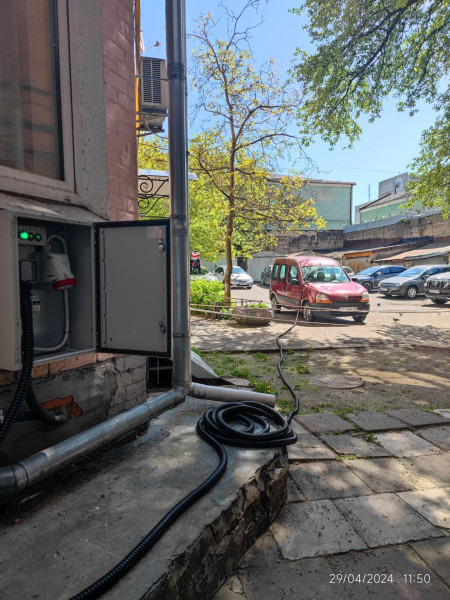
The main task of this vehicle is to transport electric energy from the nearest data center to the Metro MMR at 7 Leontovycha Street. The energy transfer from the vehicle to the node is quiet and unobtrusive, as the diesel generator located in the cargo area is never used to power the node.
The vehicle autonomously monitors its own battery charge, ensuring engineers can’t accidentally deplete it below the critical level needed to return to the data center for recharging. It also manages the battery charge at the MMR, safeguarding the MMR’s battery management system (BMS) arrays and preventing overcharging.
Neighbors are delighted and grateful, as it lets them sleep and go about their business without disturbance.
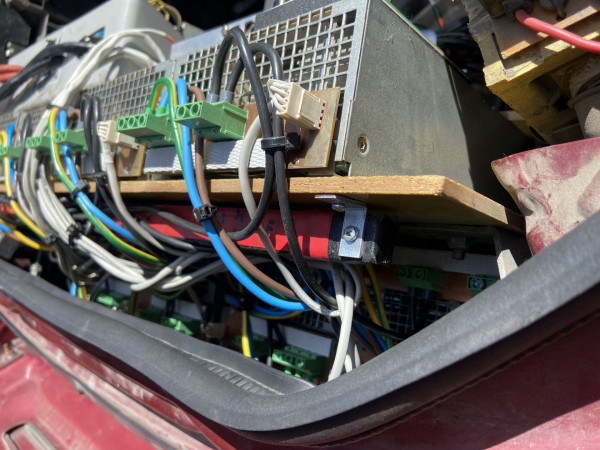
The vehicle, at heart, is a telecommunications worker. During its conversion to a high-capacity battery (equipped with a modern battery pack from a Chevrolet Bolt), power supply units from the uninterruptible power system of base station car1848tn were added as an OnBoard Charger.
Previously, such uninterruptible power systems were serviced by Proelectro, but now the car1848tn units are used only occasionally as chargers for batteries of various capacities and voltages. Nevertheless, these power supplies perform exceptionally well, operating in parallel, delivering power to a shared bus, and charging the battery. An interesting feature of these power units is that they can accept both direct and alternating current inputs, functioning as both an AC-to-DC charger and a DC-to-DC converter.
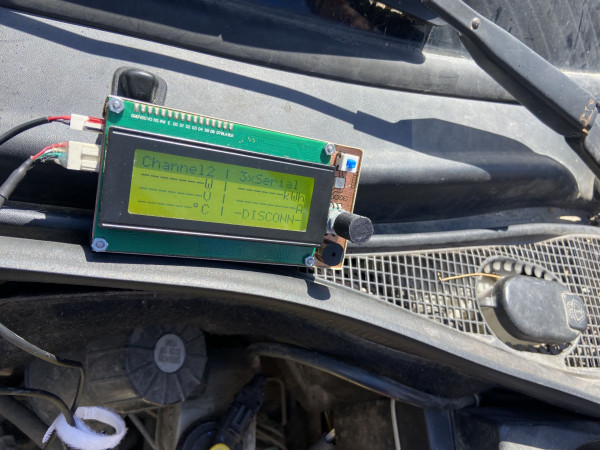
Under the hood, there are 12 of these power supply units, and IT Business Solution developed a custom charging controller on Arduino for them. The controller’s job is to regulate the current for each power unit during charging and protect each one from overload and overheating.
Additionally, the controller has a configuration module for the entire array of power units, enabling the use of reduced-power three-phase charging stations. The controller fits the vehicle perfectly, as if it were built in from the start, and reliably performs its function.
ITBiz, as always, is impressive! Before approaching them for this controller, we had no idea the company had such a diverse skill set.
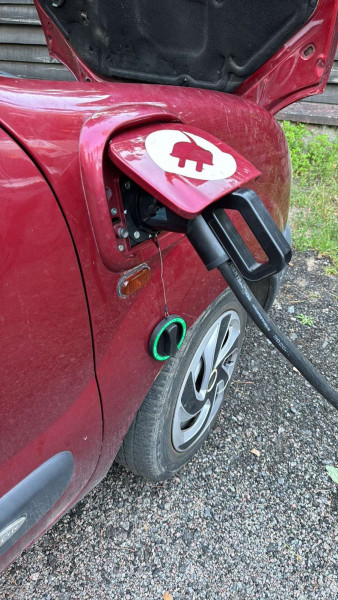
Along with the new charging controller, the vehicle received a new Type-2 charging port from ITBiz specialists, replacing the original “square” connector. This upgrade allows it to charge at standard EV charging stations without the need for adapters.
It’s as if Renault’s engineers foresaw that their port would one day be replaced with something more modern and powerful, as they designed the charging flap to the perfect size.
And what exactly this vehicle charges and how it operates—we’ll share in the next editions of our important news.
- Details
At the beginning of 2023, DTEL-IX successfully completed the migration of its network core to a new platform. The vendor of the new equipment was chosen as Arista.
- Details
Due to the fact that we can no longer cover the costs of running the diesel generator, and we are unable to finance the operation of the DTEL-IX data center under the new electricity tariffs from suppliers, starting from September 2024 all clients using the per-unit equipment colocation service have received a significantly reduced subscription fee for the placement of their equipment. However, electricity consumption is now billed according to the actual power usage of each installed unit. Actual cooling costs are also reimbursed.
All calculations for electricity and cooling are made exclusively based on the electricity supplier’s tariff, taking into account the diesel generator's operating hours.
The relevant supplement has already been sent via Ukrposhta to each service customer.
We apologize for this necessary step. We have held out for a long time without changing the colocation fees, hoping that the power supply would stabilize and the tariff would return to its previous level.
- Details
Since 01.10.2021 BE MOBILE DC does not include 2 cross-connects into rack or cage monthly fee.
DTEL-IX is responsible for all cabling infrastructure and cross-connects in the data center and will be ready to assist its partners.
- 7 Leontovicha St. is a new point of presence of DTEL-IX and metro meet-me-room in Kyiv
- DTEL-IX position on blocking Internet resources by seizing intellectual property rights
- DTEL-IX provides a Member Certificate
- DTEL-IX has joined the global MANRS initiative
- RETN and DTEL-IX together have implemented their first 100GbE Remote-IX connection
- New Client Communities on Route Servers
- DTEL-IX launches an additional node for connection to the traffic exchange point at Bemobile
- DTEL-IX. What to expect in 2017
- DTEL-IX expands international cooperation
- ATMAN expands network coverage by connecting to another foreign internet exchange point — DTEL-IX in Kyiv
- New point of presence opened in Kyiv
- 100Gbps. Who is to blame, and what to do next?
- IPv6 Launch
- The exchange is growing...
- Own point of presence opened at Leontovycha, 9
- Documents for participants published
- More and more 10Gbps connections
- 10G ports
- Looking glass
- Backup Routeserver (RS1) launched
- RS0 put into operation
- New member connected
- Project Launch